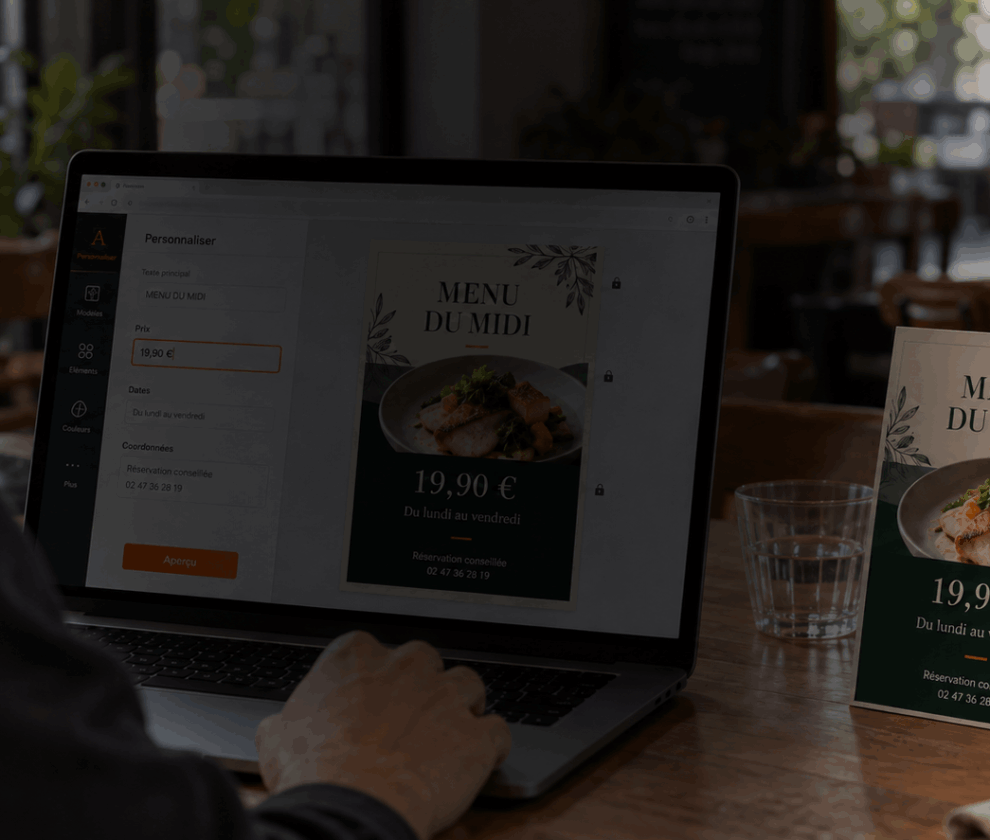

A sales representative needs to customise a poster for a local promotion.
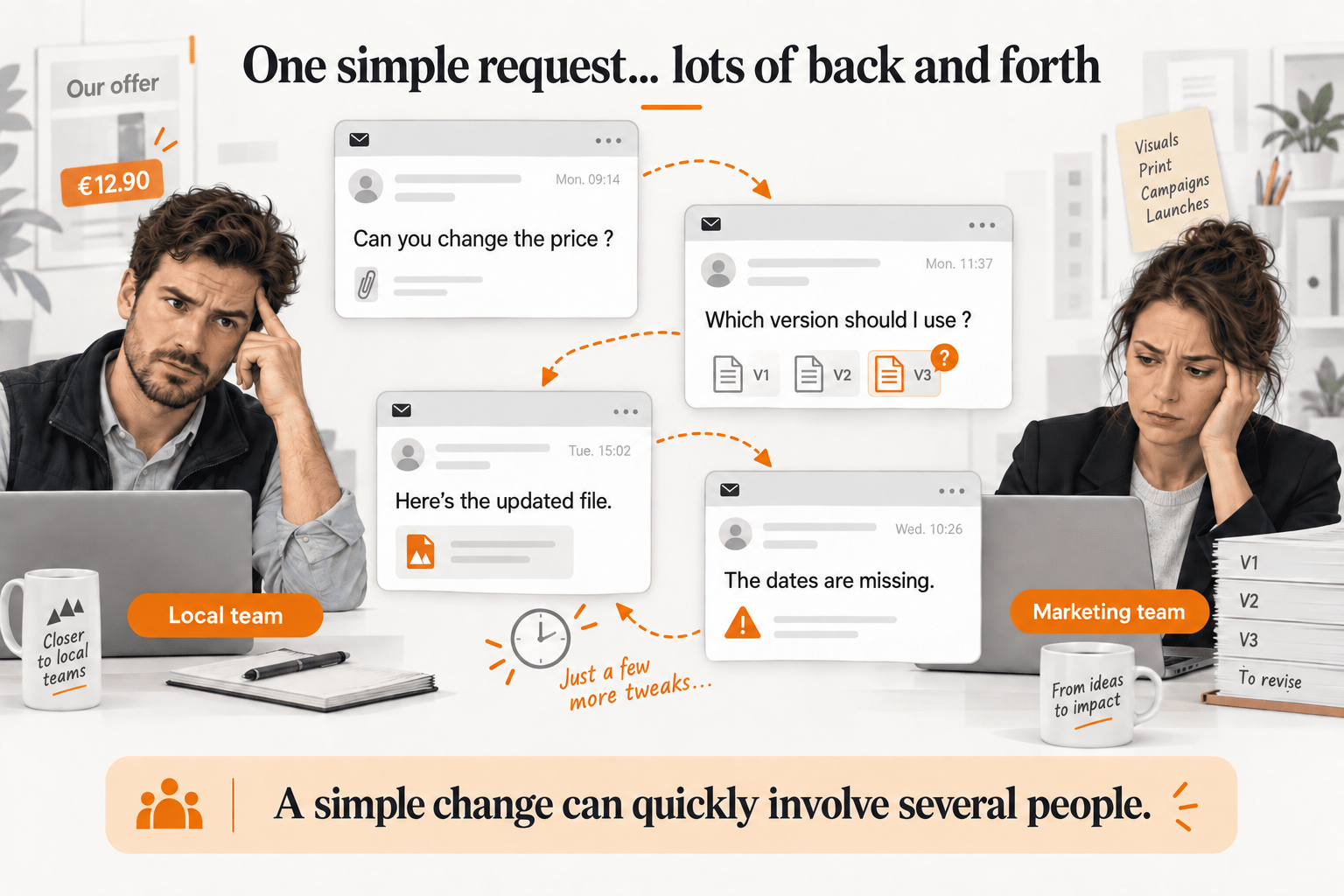
He sends his request to the marketing team, specifying the price, dates and contact details for the outlet. The marketing team finds the right file, makes the changes, checks that the design follows the brand guidelines, then sends it back for approval.
The request seemed straightforward. Yet it involved several people and multiple rounds of back-and-forth before the poster was ready to use.
This is a common scenario in companies that rely on a sales network, distributors or multiple locations. Local teams need to act quickly, while head office must maintain the quality of marketing materials and ensure brand consistency.
Does this mean choosing between local autonomy and central control? Not necessarily.
Why do local teams still depend on head office?
When a sales representative or a local branch needs to customise marketing materials, they don’t always have the right file or the tools to make the changes themselves.
Several challenges can then arise:
- marketing materials are scattered across folders, shared drives and emails;
- multiple versions of the same document are in circulation;
- design software requires graphic design skills;
- customisation guidelines are not clearly defined;
- every customisation must be reviewed by the marketing team;
- ordering and production are managed separately.
Local teams therefore rely on head office even for simple changes. Meanwhile, the marketing team spends part of its time searching for files, correcting information and producing similar versions of the same materials over and over again.
These requests add to an already substantial information workload. According toObservatory for Information Overload and Digital Collaboration, an employee handles an average of 169 emails per week. The 2026 study, based on an analysis of how nearly 30,000 employees use digital collaboration tools, also found that 51% of emails receive a reply within an hour.
These figures are not specific to marketing teams, but they highlight the pressure to respond quickly that comes with day-to-day requests for marketing materials.
Autonomy or control: do you really have to choose?
To address this challenge, companies often consider two contrasting approaches.
The first approach is to keep all production at head office. The marketing team then controls the creation and approval of every piece of marketing material. This safeguards brand consistency, but turnaround times can increase and repetitive requests can pile up.
The second approach is to give local teams more freedom. They can act more quickly, but may use outdated files or create materials that do not fully reflect the brand’s visual identity.
Both approaches soon reveal their limitations.
Yet, local autonomy and central control can go hand in hand. Teams can be allowed to customise certain elements while keeping those that ensure brand consistency protected.
This is the principle of autonomy within clear guidelines: Head office sets the guidelines, and local teams work within them.

What local teams can customise… and what the brand keeps protected
Local needs generally involve specific details.
Depending on the type of marketing material, a sales representative, distributor or local branch may need to update:
- an address or contact details;
- details of a retail outlet;
- campaign dates;
- a price or a local offer;
- a featured product;
- a photograph chosen from an approved selection
- a short introductory text.
At the same time, the core elements of the brand’s identity remain protected:
- the logo and its proportions;
- the colours;
- the fonts;
- the overall layout;
- the mandatory legal information;
- visuals that must not be replaced;
- the technical specifications required for printing.
The user therefore doesn’t start from scratch. Instead, they customise a template that has already been designed and approved by the brand.
This distinction is essential: Autonomy is about adapting marketing materials to local needs, rather than defining the brand’s visual identity.

The role of marketing is evolving
Giving local teams more autonomy does not eliminate the role of marketing. It allows the marketing team to refocus on its core responsibilities.
Rather than handling every variation, the marketing team establishes the following in advance:
- available templates;
- the customisable elements;
- the design guidelines;
- the approved content;
- the permissions assigned to each user;
- any approval workflows required.
Brand control then no longer relies solely on manual checks carried out after each request. It is built into the design of both the marketing material and the customisation process from the outset.
The marketing team can then devote more time to strategy, campaign development, understanding needs and refining the brand’s identity.
What autonomy means for local teams
For sales representatives, distributors and local branches, the main benefit is being able to respond more quickly.
They can access up-to-date marketing materials and customise them to suit their local needs without lengthy back-and-forth with head office. They don’t need graphic design software skills or have to recreate the materials themselves.
This autonomy can make it easier to:
- launch a local promotion;
- support a customer or retail outlet;
- customise a poster or flyer;
- personalise a menu or price list;
- prepare for an event;
- order marketing materials tailored to a specific geographical area.
Marketing materials become easier to put to use when they are needed most.
Local autonomy can strengthen your brand
At first glance, giving local teams more freedom may seem to put brand consistency at risk. Yet autonomy within a clear framework often has the opposite effect.
It makes it easier for teams to use the right materials, rather than searching for an outdated version or creating their own workaround. This helps ensure that centrally developed communications are rolled out more effectively and better tailored to local needs.
Giving local teams more autonomy doesn’t necessarily weaken the brand. It can strengthen its presence, provided the guidelines are clear and the tools are easy to use.
How can you tell when local teams lack autonomy?
Several signs may suggest that your current setup is reaching its limits:
- the marketing team regularly receives the same requests for changes;
- a simple change requires several rounds of back-and-forth;
- sales representatives struggle to find the right marketing materials;
- outdated versions are still being used;
- some materials are recreated locally;
- promotions are delayed by lengthy approval processes;
- the workload grows as the number of users or locations increases.
When these situations keep recurring, it may be time to move from handling requests individually to a system where guidelines are established from the outset.
Head office sets the framework, local teams take action
Giving local teams autonomy doesn’t mean giving up control over your brand.
It’s about clearly defining what each user can customise while protecting the core elements of your visual identity. Local teams can respond faster, while marketing retains control over the shared framework.
The role of head office then evolves: it no longer needs to produce every local version itself. Instead, it enables teams to use, customise and put marketing materials into action at the right time.
Would you like to give your network more autonomy?
At IPOCAM, we build bespoke web-to-print platforms that connect brands’ ambitions with the practical needs of their networks. Our goal is to make local communication simpler and more responsive while maintaining brand consistency.